A New Chapter: Introducing The Veil

I’m thrilled to share the launch of my new Substack, The Veil, a space where I pull back the curtain on my creative journey and invite you to step inside the world of building a modern luxury brand.
Over the years, I’ve realized that the stories behind ideas—the inspirations, the experiments, the successes, and even the failures—are just as important as the finished work itself. The Veil is my attempt to capture that process, to explore the layers that often remain unseen, and to share the way I think, design, and innovate.
Here, you’ll find reflections on creativity, glimpses into the philosophies guiding my design decisions, and insights into how a modern luxury brand is built from the ground up. It’s a space for curiosity, for conversation, and for anyone who’s fascinated by the intersection of art, design, and thoughtful craftsmanship.
Launching this Substack is more than just sharing content—it’s about building a community of like-minded thinkers and creators who appreciate the beauty and rigor behind thoughtful design. I’d be deeply grateful for your support: subscribe, read, and if something resonates, share it with others who might enjoy the journey.
I hope The Veil will inspire, provoke thought, and offer a rare glimpse into a world that I’ve been passionate about bringing to life. Thank you for being part of this journey with me.
— Jameel
Copyright © 2025 Jameel Gordon - All Rights Reserved.
Threads of a Brand

It’s a little odd, unexpected, unplanned and a pleasant surprise that seemed to come out of nowhere. By “nowhere,” I mean the depths of my imagination. I’m having a lot of fun with The Veil.
Storytelling has always been a central part of my process. Anyone who’s ever met with me in person or virtually knows that a large part of our time together was often consumed by my stories. In fact, in one of the last meetings I decided to take, I got this feedback: I stared blankly at the person on the other side of the screen as they politely told me they couldn’t help me because, essentially, I had just told them a story. I understood their point—it wasn’t a great fit for collaboration, and we both agreed it wasn’t the right time.
Despite that, I gave in to much of the pressure to launch a Substack, which I randomly titled The Veil. I decided to focus it on fashion and document the story of launching a luxury brand. Each post, which currently captures my thinking and mostly strategic decision-making, is forming an enormous wealth of ideas around brand positioning, marketing, products, ethos—basically endless possibilities. I’m looking forward to developing it to its full potential, and that’s all I’ll say for now.
In the meantime, I encourage everyone to start exactly where they are, with what they have, and tell their story—or tell a story—and see where it takes them. Even more important, however, is knowing your story: know your history, your family’s history, and be mindful to distinguish facts from shared truths and from fiction. It’s vital to be honest and objective with yourself.
Oh yeah this is me and I’m right where I’m supposed to be. 🤣

Copyright © 2025 Jameel Gordon - All Rights Reserved.
Wait…

This would be my advice to everyone: wait. I’ve learned that when I’m uncertain about something, the best decision I can make is to wait. Maybe this “law,” so to speak, only applies to me so take it, test it, and see if it serves you. But in this case, I believe there’s wisdom here for all of us: let’s wait.
As I shared with a colleague the other day: here’s the deal… Anyone right now who isn’t a cloud-based AI company building out core AI infrastructure is selling snake oil. Everything else can wait until that foundational infrastructure is completed and its second- and third-generation iterations especially sustainable energy solutions are in place.
Here’s why: what’s happening right now is a massively complex, competitive free-market undertaking. I remember an early Joe Rogan podcast, before he became the Joe Rogan we know now, where he said something that stuck with me. I’m paraphrasing, but his point was: just because everyone is standing in a circle holding hands and singing kumbaya doesn’t mean it’s all love.
Let’s not get swept up in the hype of Big Tech’s money grab. The circulation of capital and the frantic building of infrastructure that, if I’m putting it lightly, follows a cycle we’ve all seen before. I learned this studying real estate and the real estate families. When I was a real estate broker, I didn’t just study the market I studied the people who’d been in the game for generations. And what you learn is that these cycles always repeat. Newcomers rush in trying to emulate the old guard, and the kicker is always the same: greed. The winners play the slow and boring looks like we’re doing nothing but eating bon bons long game.
Right now there’s a lot of money flying around, a lot of projects being built, and a lot of companies are going to get stuck holding the bag. And when that happens, there won’t be money in them if you know what I’m saying.
So let’s wait. We’ve seen this before with the development of the internet. Let the demolition derby play out. Then we’ll walk in, clear the wreckage, and build on top of the lessons learned.
Copyright © 2025 Jameel Gordon - All Rights Reserved.
Beyond the Obvious: Why Real Estate Alone Isn’t Enough in the Age of Abundance

Whenever I write or speak about the future of the economy, about investments, about how we spend our most valuable asset; time, I always hear the same immediate response: “Real estate, dummy.”
And yes: I know real estate can be a great investment vehicle. It’s tangible. Historically appreciating. For many, it’s tied to the foundation of the American Dream. The almighty house with a white-picket fence.
But here’s the critical point: real estate cannot and should not be the only focus of investment. Its value is entirely dependent on the broader economic apparatus: wages, employment, innovation, technology, and financial systems. Without a healthy economy supporting it, even the most “secure” property is vulnerable. I explore this in more depth in The Double-Edged Sword of Real Estate Investment, where I examine the hidden risks of over-relying on real estate.
Think about history: despite there being enough livable space for all humans, scarcity of perceived value has always led to competition — imperialism, colonialism, and war. If we treat land as the only true measure of wealth, we risk repeating these conflicts on a global scale. Real estate is valuable, yes, but it exists within a system that creates and sustains that value.
That’s why other investment vehicles such as stocks, bonds, commodities, and increasingly, AI-driven assets exists. They help maintain the stability and security that allow real estate to hold value. Without these, the foundation of property investment erodes. Does this make sense?
We are entering what I call the Age of Abundance. In The Age of Abundance: When AI Eats the Software That Ate the World, I explore how AI is reducing the marginal cost of value creation, enabling innovation, and making possible entirely new systems of wealth, productivity, and sustainability. In this new paradigm, focusing solely on real estate is a losing strategy. Whoever builds a truly self-sustaining society first — one that doesn’t depend solely on existing economic structures — will have a decisive advantage. This isn’t about democracy as we know it. AI and autonomous systems are set to make democratic capitalist societies a relic of the past. What’s emerging is something entirely new and I’m actively working on a theory and a framework to define it.
As I argue in The Future Is Here: How AI Will Disrupt Every Industry and What We Can Do, AI is touching every industry, creating new ways of producing value and new pathways for wealth, safety, and security. In the Age of Abundance, investments are no longer about owning scarce resources alone; they’re about creating systems, harnessing innovation, and creating self-sustaining networks that function independent of traditional economic failings and protect people and the planet.
So yes, real estate is important, but it’s only one part of a much larger ecosystem. Anchoring yourself solely in property is anchoring in yesterday’s economy. Time, technology, diversified assets, and the strategic construction of self-sustaining systems are the keys to thriving in what’s next. The house with the white picket fence may remain aspirational, but the real winner in the Age of Abundance, is that value creation is directly linked to the support of full societal resilience and it outweighs square footage and the delusive lot size. 🏁
Copyright © 2025 Jameel Gordon - All Rights Reserved.
The Sovereignty of Well-Being

There is a quiet revolution happening so subtle it rarely makes a sound. It doesn’t march, or shout, or trend. It begins in the smallest of places: a person deciding that their own definition of enough will no longer be borrowed from someone else.
For centuries, the power to define wellness; what it means to live well, to feel whole, to be human, has rested in the hands of systems and structures much larger than ourselves. Governments, corporations, schools, religions, and industries all with their own metrics, their own language for what counts as “balanced,” “productive,” “healthy.”
And for a while, we listened. We allowed these standards to become the yardsticks of our worth. We internalized their charts and goals. We learned to smile for wellness campaigns that did not know our names, to wear devices that tracked our sleep but not our sorrow.
But no institution, however benevolent its intent, can feel what we feel. No algorithm can sense when our laughter is real. No public health model can define the meaning of peace in a single human heart.
Well-being, if it is to be authentic, must be reclaimed not from experts, but from the unseen hierarchy that tells us how to be human.
The Eight Dimensions, Reimagined as a Language of Freedom
The Eight Dimensions of Wellness first formalized by Dr. Peggy Swarbrick and widely adopted by SAMHSA describe a holistic framework for living:
• Emotional: The art of balance, the courage to feel without fear.
• Physical: The reverence for a body that carries us through the world.
• Occupational: The merging of purpose with practice, where meaning becomes our true currency.
• Social: The web of friendship and belonging that reminds us we’re never alone.
• Spiritual: The still point within, where peace and kindness take root.
• Intellectual: The curiosity that keeps us growing long after the lesson ends.
• Environmental: The bond between the human and the habitat that sustains it.
• Financial: The structure that allows safety, dignity, and wise stewardship.
These eight pillars are not commandments. They are constellations. They exist to help us navigate, not to dictate our destination. Every individual must arrange these stars differently. For one person, the light burns brightest in spirituality and silence. For another, it shines in movement, laughter, and the thrill of creation. For another still, it flickers gently in recovery and rest. There is no single way to balance a universe.
Power, Freedom, and the Personal Definition of Enough
When power defines wellness, it becomes performance. When the individual defines wellness, it becomes liberation. Well-being is not a finish line to be reached or a brand to be purchased; it is a dialogue between the self and the conditions that surround it. It shifts when we shift, bends when we break, deepens when we grieve, expands when we love.
Each of us must decide how to measure it. For some, wellness means rising early to greet the day. For others, it means sleeping through the morning after a long night of healing. For one, it means running marathons. For another, it means learning to walk again slowly, and gently.
This is the essence of personal sovereignty: the right to define what a good life looks like, and the refusal to let power name it for us.
The Future of Wellness is Decentralized
The next evolution of human society will not simply be powered by smarter machines or larger systems, but by more self-aware humans. Individuals who take back the authorship of their well-being and craft their own definitions of health, happiness, and purpose.
This isn’t rebellion for its own sake; it’s responsibility. To know yourself is the highest form of governance. To live in alignment with that knowing is the purest form of power.
Imagine a world where we all define our own wellness and still choose to care for one another. Where our differences in pace, in practice, in priorities, are not signs of division, but of wholeness. A world where institutions exist not to prescribe, but to support. Where the collective doesn’t conform, it listens.
The revolution of wellness is already here. It starts every morning you decide to live by your own rhythm, every time you turn inward and choose to trust yourself over the noise.
Because the truth is simple: No one can define your well-being better than you. And no society can call itself truly free until every person holds that power in their own hands.
Copyright © 2025 Jameel Gordon - All Rights Reserved.
The Imperative of Personalized Well-Being

In a world increasingly defined by homogenization, virality, and mass replication, we risk forgetting the individual: the core of what it means to be human. Humanity, in its collective splendor, offers a vast canvas of shared experience, culture, and knowledge. Yet within this shared existence lies a paradox: the collective can only truly flourish when the well-being of each individual is recognized, honored, and nurtured.
This recognition demands more than generic solutions or broad trends. It calls for intricate, intimate personalization, crafted with an understanding of the unique rhythms, aspirations, and vulnerabilities of each person. Just as no two minds are identical, no two paths to fulfillment are alike. True societal progress is inseparable from the attentive cultivation of individual well-being, a baseline established not by metrics or averages, but by the lived experiences, values, and inner landscapes of each member of our human collective.
To thrive as a society, we must move beyond treating people as data points or replicable patterns. We must design experiences, communities, and systems that respond to the complex interplay of the personal and the collective and that honor the subtle variations of human desire, health, and purpose within each of us. Only then can we reconcile individuality with collectivity, ensuring that humanity’s strength is not just in numbers, but in the richness of the individual lives that compose it.
In essence, the next evolution of human society will not be dictated solely by technology, efficiency, or shared norms. It will emerge from the deliberate attention to each person’s unique baseline of well-being, and from the willingness to translate that understanding into practices, systems, and relationships that support both the self and the whole.
Copyright © 2025 Jameel Gordon - All Rights Reserved.
What Truly Separates Us

We live in a world that rewards imitation over invention. Humans, in pursuit of security, belonging, and recognition, have traded their uniqueness for formulas, trends, and scalable ideas that “worked” for someone else. We read the same books, follow the same gurus, echo the same philosophies, and cultivate communities built on shared values yet beneath this facade of alignment lies a fragmented, polarized, and increasingly hollow society. The very systems and movements that promise order and well-being have instead suppressed the qualities that make us human, leaving us in a state of curated public lives and chaotic private realities.
Deviation is punished. Creativity is constrained. Those who think differently, act differently, or live differently are branded “other” and told, quietly or openly, to conform. This is not accident; it is the logic of a world optimized for predictability, scalability, and control. Systems, institutions, and cultural norms were designed to replicate stability not meaning. In doing so, they manufacture sameness, concentrate power, and reward compliance. The individuality of the many becomes the mimicry of the few.
Even our private worlds are no longer private. Ideas, creations, and innovations, the traces of our humanity, are captured, cataloged, and recycled. The distinctions that should define us are reduced to labels, reposts, and viral templates. We live in a globalized echo chamber where our “original” contributions are rarely original, and the illusion of personal expression becomes indistinguishable from mass-produced conformity. Power accumulates in the hands of the few, while the rest of us regurgitate the signals, styles, and identities of those same people all in an attempt to share in the wealth, fame, and notoriety.
And yet, the truth is unavoidable: what separates us cannot be mass-produced, measured, or controlled. It is our capacity to act intentionally, to assert our humanity in the face of systems built to erase it, to make choices that are unreplicable and uncompromising. This is the essence of massive individualism. It is not a luxury. It is a resistance. It is the act of reclaiming our agency, our creativity, and our ability to define what flourishing truly means for ourselves, and for no one else.
The world may try to flatten, standardize, and predict us, but it will never capture the irreducible human spark: the choices, the deviations, the imagination that refuses replication. To live fully is to cultivate that spark, to act with deliberation and authenticity even when systems demand repetition, and to assert individuality as a force that resists the manufactured sameness of the industrialized and algorithmic world.
Those who reclaim this power will not merely survive in the age of conformity they will define it. They will be the living proof that what separates us is not what we consume, but what we choose to create, embody, and leave behind in this world.
Copyright © 2025 Jameel Gordon - All Rights Reserved.
Baselines of Power: Why Well-Being is a Question of Authority
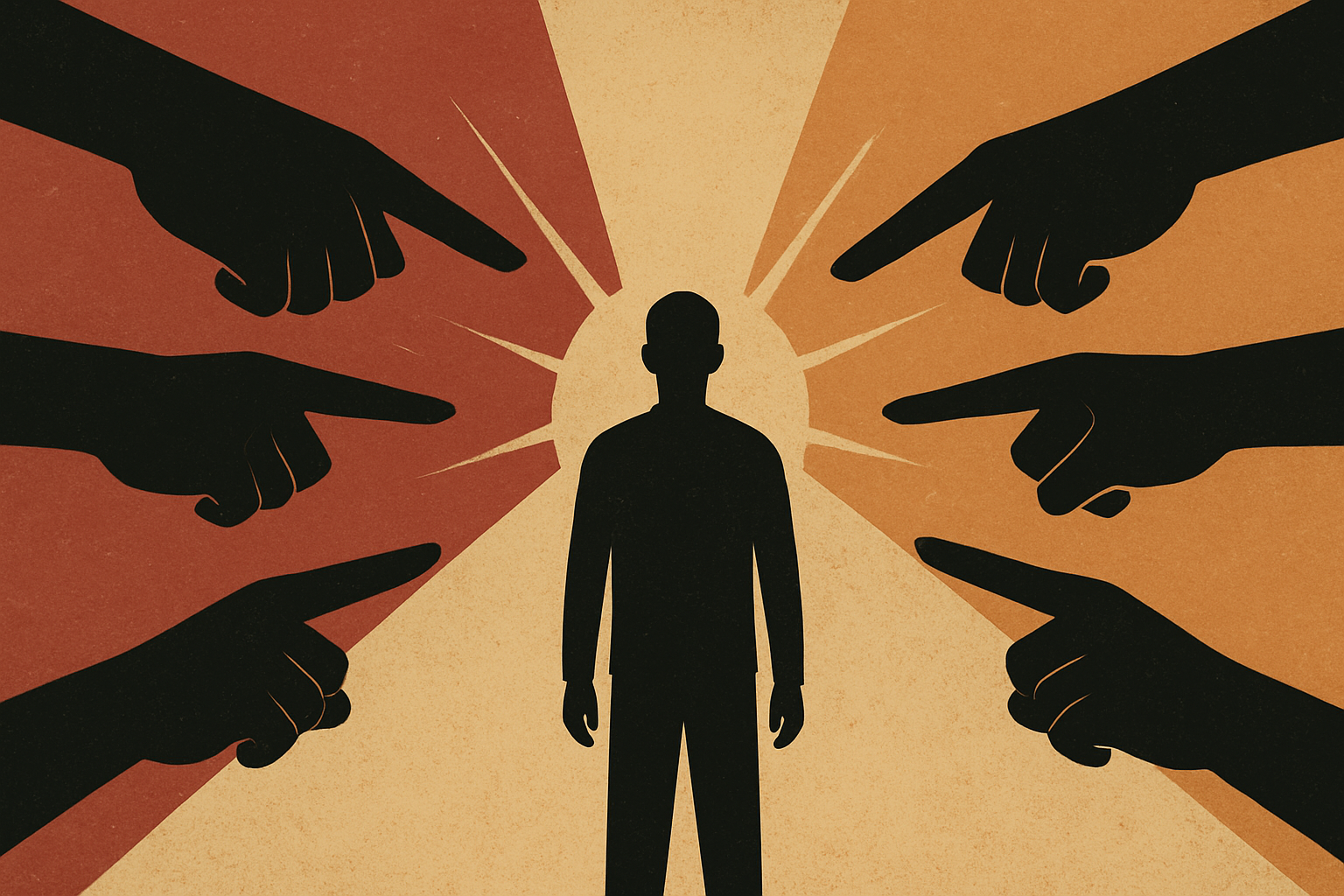
Whether we like to admit it or not, humans operate with the belief that there are general standards or baselines for well-being. Across societies, cultures, and institutions, we act as though there are certain conditions, behaviors, or achievements that define a “good” or “healthy” life. The tension, however, lies not in the existence of these standards, but in who gets to define them. This question: who holds the authority to declare what counts as well-being gives rise to hierarchies of power. Authoritarian institutions such as governments, churches, and other centralized authorities are often built upon these definitions, and one of the primary ways they communicate and enforce these baselines is through what we commonly call “shared values.” These shared values operate as instruments of social control, shaping norms that people are expected to accept, internalize, and follow.
When an individual proposes ideas of standards or baselines that diverge from those established by existing power structures, opposition and obstruction inevitably emerge. Even if the individual’s intention is genuinely to promote well-being, the act of challenging institutional authority is perceived as a threat. Defining well-being is, at its core, a mechanism of power: whoever controls the baseline controls the levers of social, moral, and political influence. This is why conflicts over standards are rarely just about ideas they are contests over authority, legitimacy, and control.
The paradox, however, is that while humans broadly believe in general standards for well-being, any attempt to impose these from above inevitably reflects the values and priorities of the authority, not the individuals who are subject to them. Contentment or subjective satisfaction alone does not equate to true well-being, and yet institutional baselines often fail to account for the lived realities, values, and choices of diverse communities. As a result, hierarchical imposition of standards regardless of intent when imposed violates the fundamental principles of the very standards that are being established.
The solution to this tension lies in massive, large-scale individualism. True general standards or baselines for well-being cannot be imposed from above; they must emerge from the autonomy of individuals. By decentralizing authority and recognizing that each person is best positioned to determine what flourishing means for themselves, the problem of top-down imposition is dissolved.
Standards then become a reflection of lived experience, choice, and experimentation, rather than instruments of control by groups of people. In this sense, redistributing decision-making power to individuals at scale is not just a philosophical argument it is the only viable path to a genuine understanding of well-being that is both universal in intent and authentic in application.
In essence, the struggle over well-being is a struggle over power. Institutions maintain control by defining baselines; individuals challenge that control when they propose alternatives. Recognizing this, the path forward is not merely about negotiating metrics or articulating “shared values.” It is about reclaiming authority for individuals, allowing them to define and enact well-being for themselves. Only through such large-scale individual autonomy can a truly meaningful baselines for human flourishing exist and we can begin to mitigate injustices and resolves on a global scale.
Copyright © 2025 Jameel Gordon - All Rights Reserved.